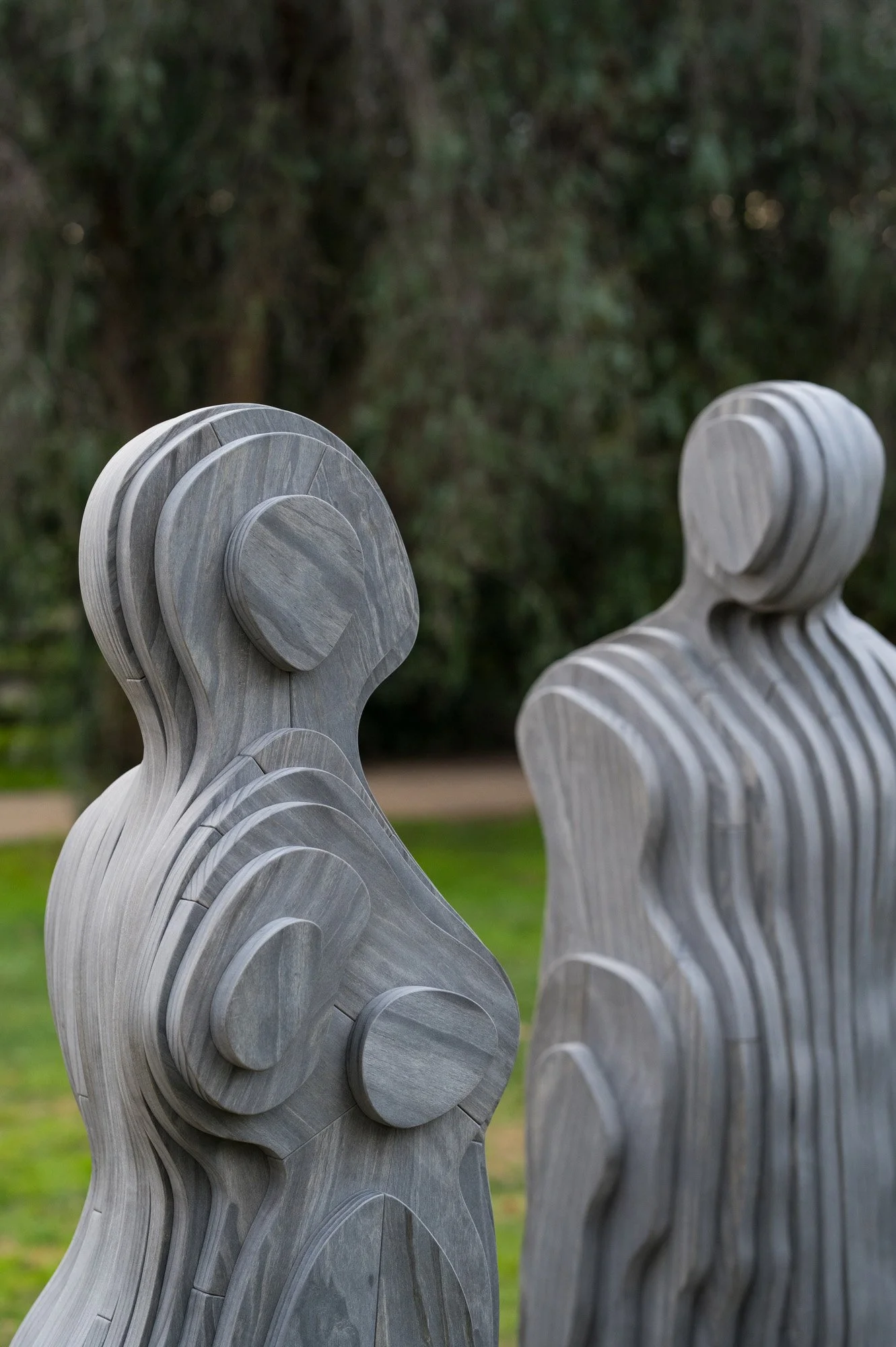
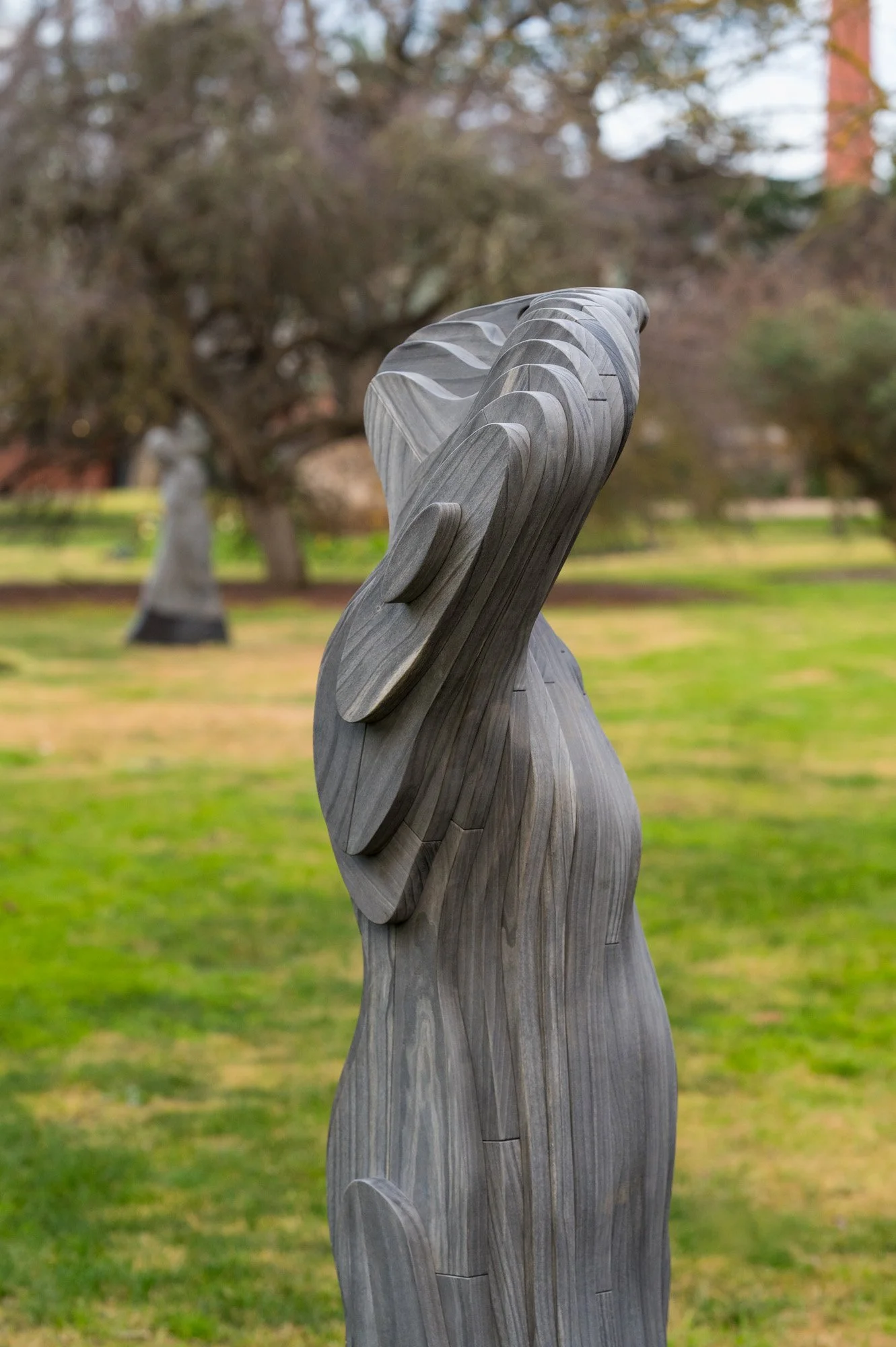
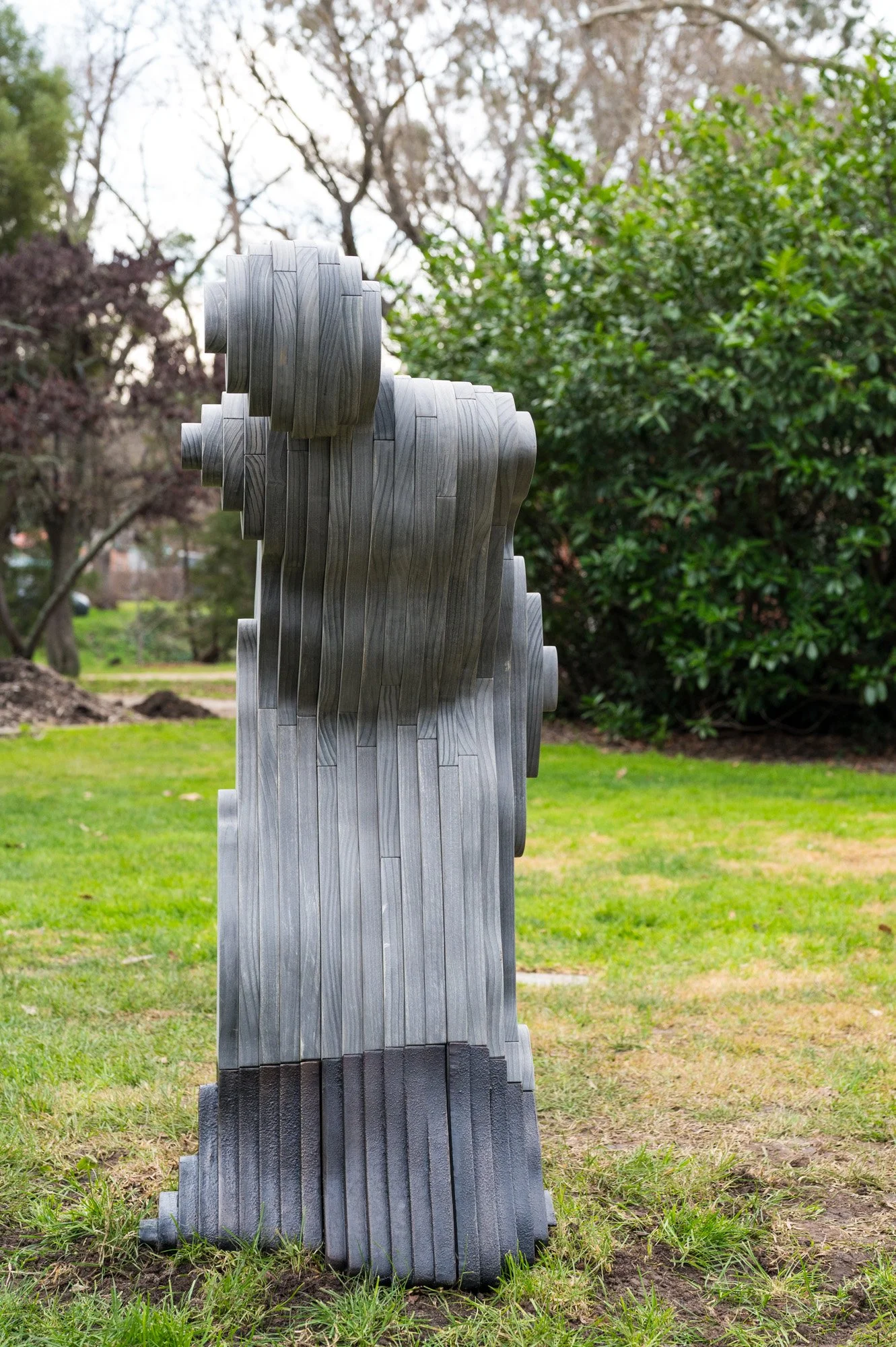
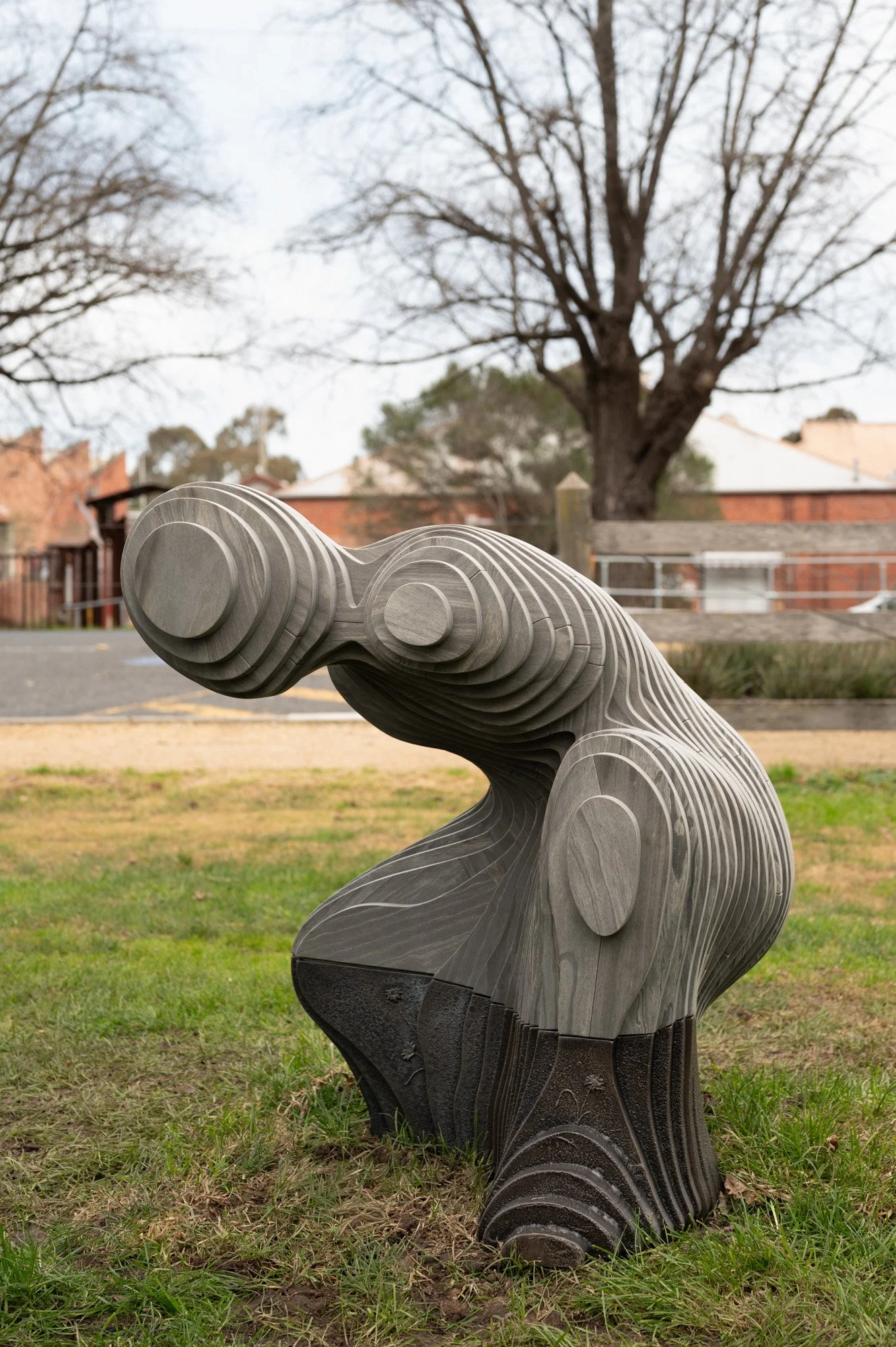
Acetylated timber, bronze
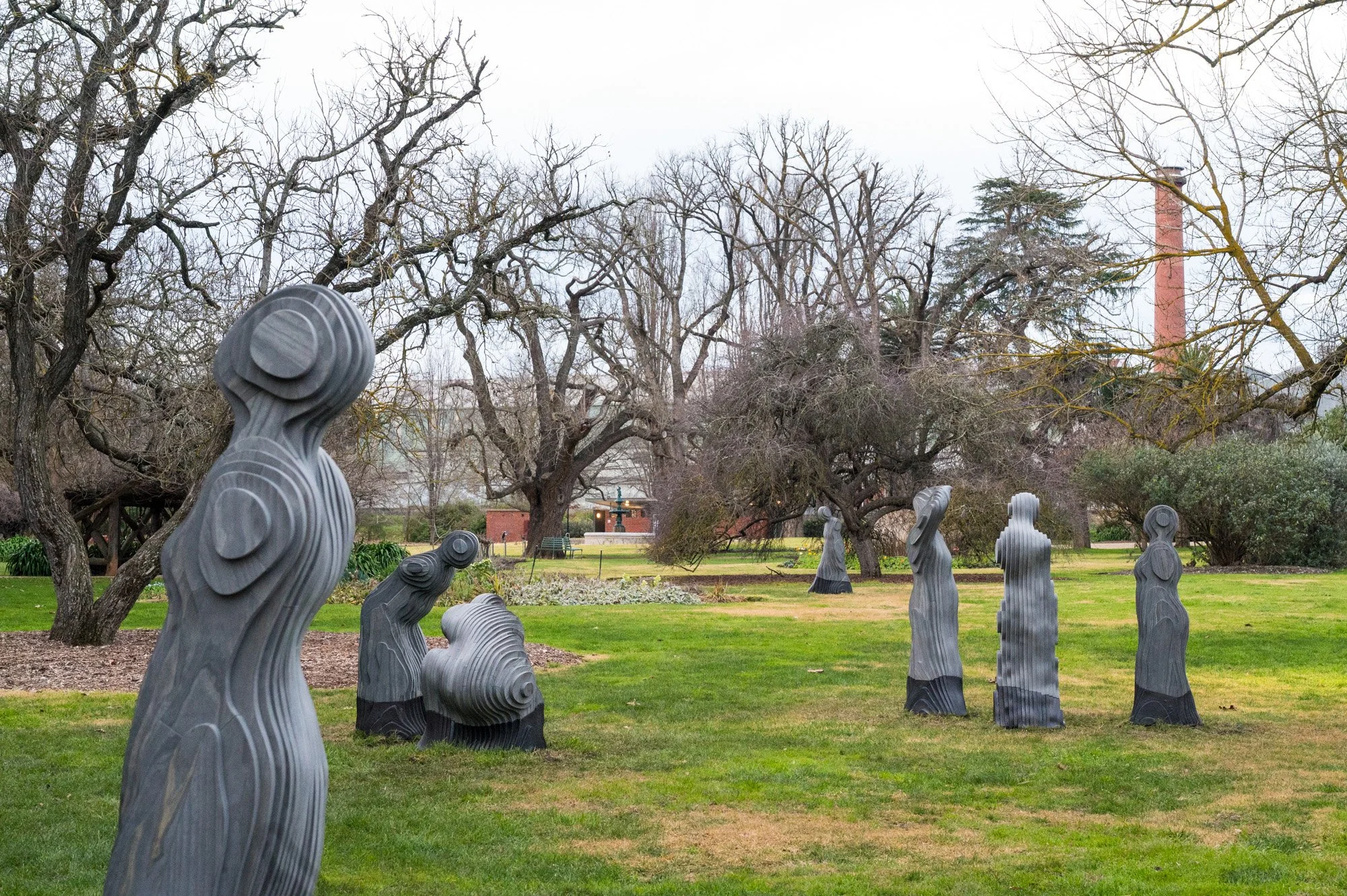
Castlemaine Botanical Gardens, Walker Street Entrance.
All images by Penny Ryan.
“Wildflowers” was commissioned by Mount Alexander Shire Council to celebrate the seven women who founded Castlemaine Art Museum and Gallery in the early 1900s: Mary Leviny, Lilian Sheridan, Alice Waterhouse, Winifred Brotherton, Elsie Barlow, Mary Brough Woolley and Mrs Cox.
“Wildflowers” celebrates the ways in which Castlemaine Art Museum and Gallery came into being through these seven trailblazing women being present with each other – sharing their interests, their time and their knowledge – and how this communality resulted in them pushing boundaries, standing in solidarity for better representation of women in art, and building something of great significance to Castlemaine: the Castlemaine Art Museum and Gallery. The artwork commemorates the important legacy of these women and highlight their contribution to the cultural life and art of our town and region. It also highlights their strong connection with local flora and fauna and the Botanical Gardens, and the ways in which they appeared to find joy and solace in observing and collecting local specimens and building knowledge around native species.
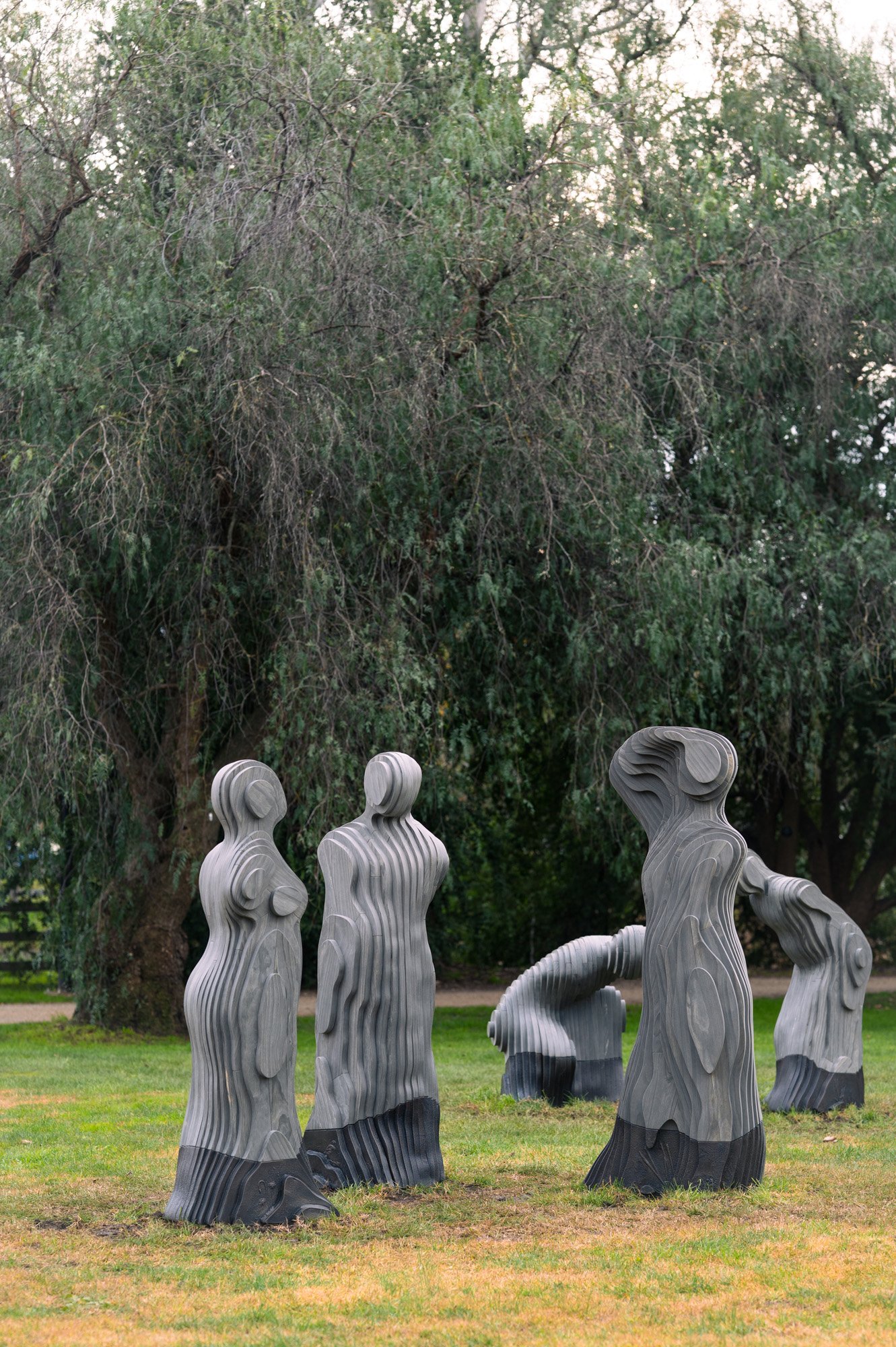
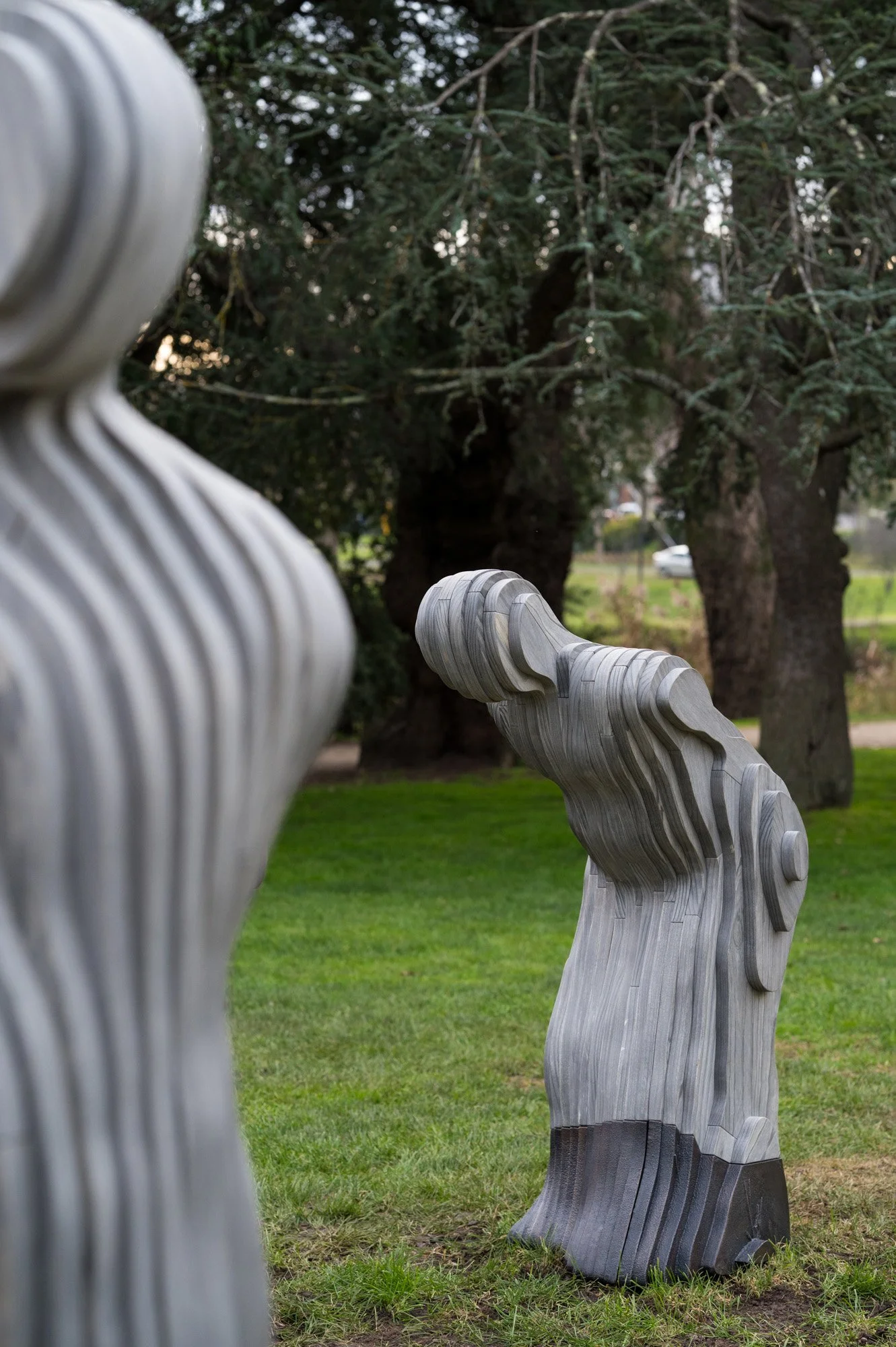
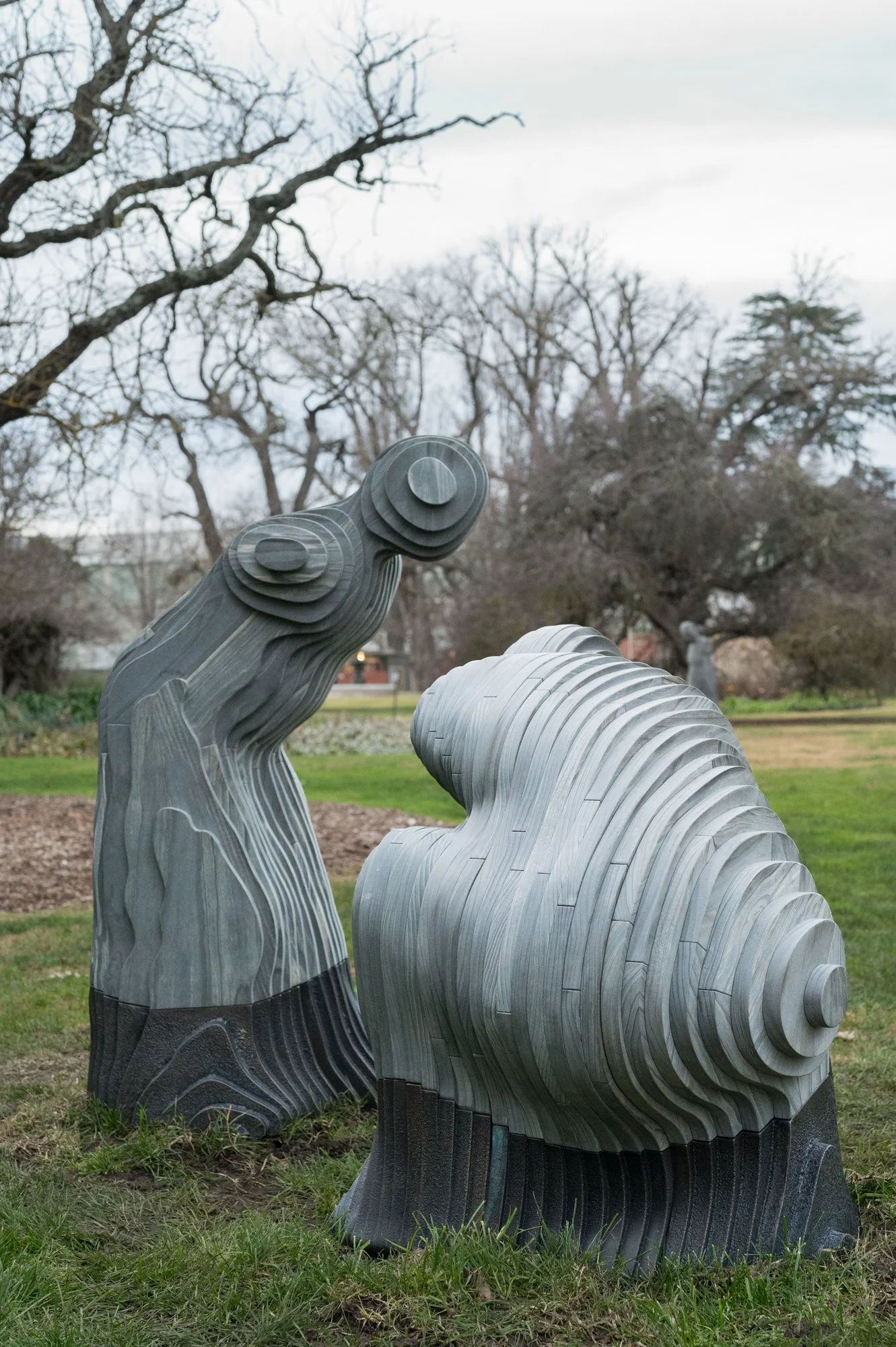
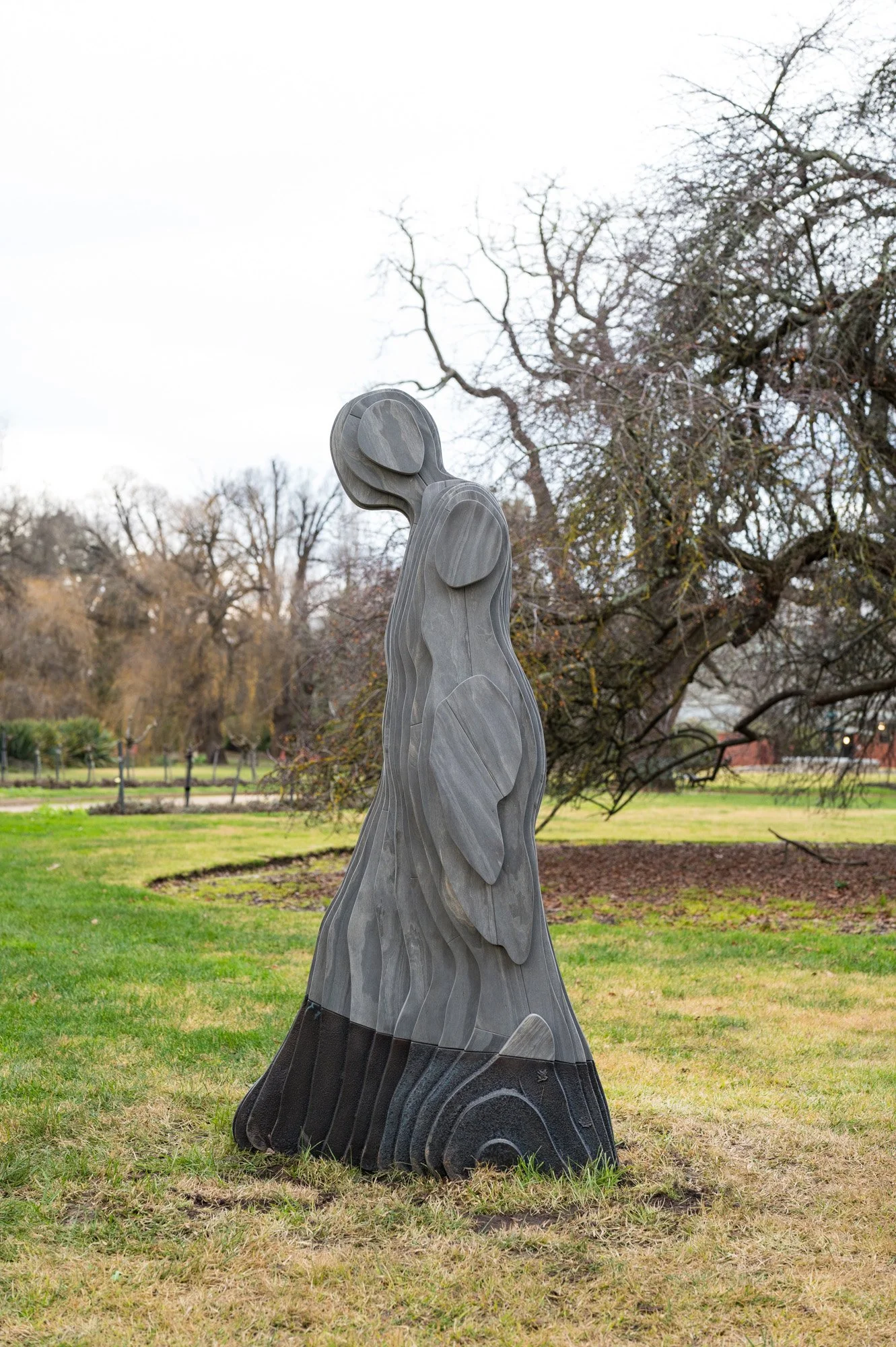
Approaching the Walker St entrance of the Castlemaine Botanical Gardens, visitors encounter a series of seven timber sculptures on the grassy area – a direct reference to the seven women who founded the Castlemaine Art Museum and Gallery. These abstracted, loosely human figures appear to be engaging directly with the gardens. One is looking up into a tree, another crouching down to inspect a flower. A few are standing as if talking with each other, or inspecting something on the ground together. They are not raised on plinths or heightened, but stand with us on the grass.
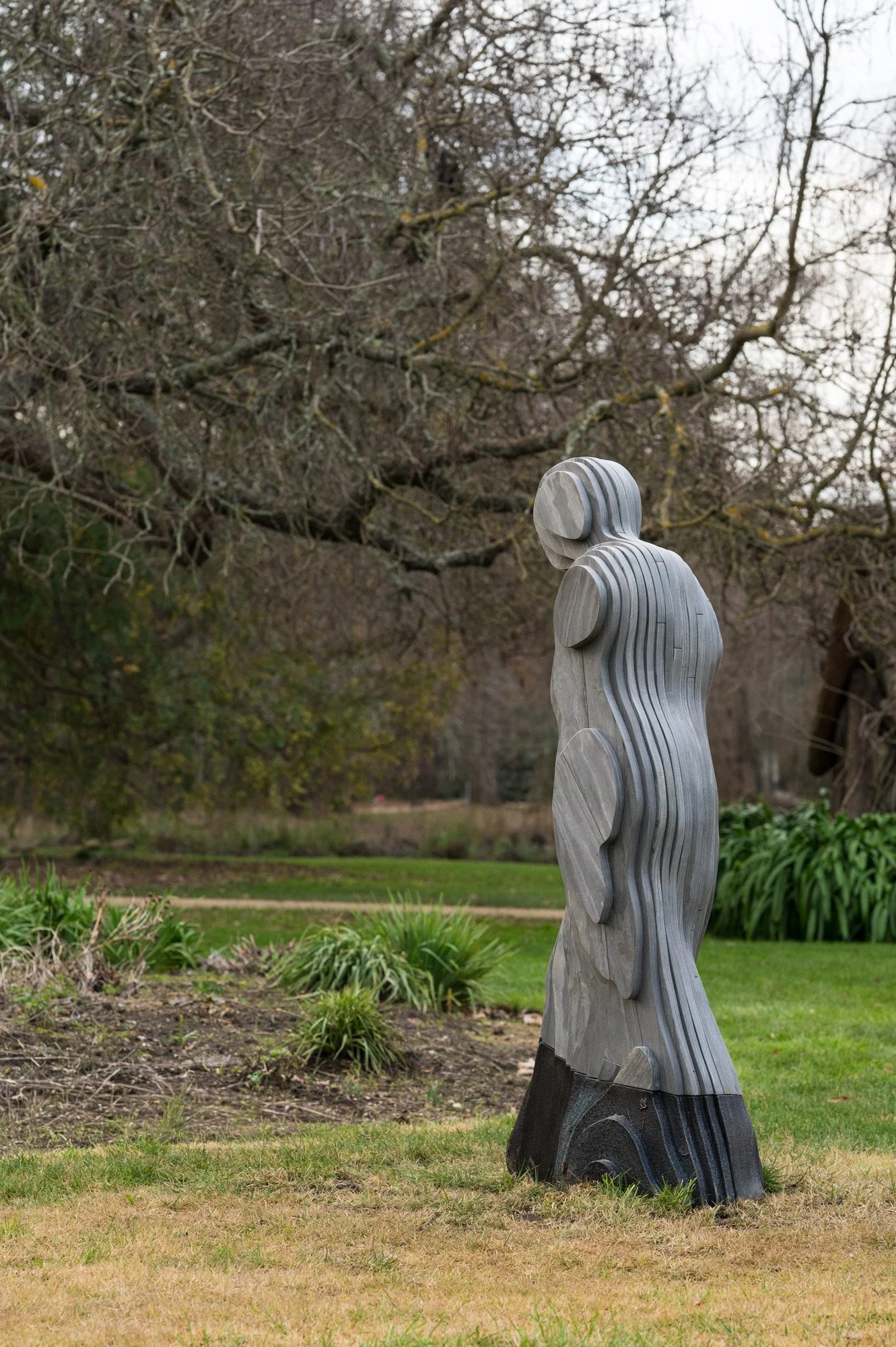
The use of timber as the primary material interlinks with the concept and site aesthetically and materially. The aesthetically “softer” material qualities of timber sit in contrast to many historical artworks which memorialise men and which are made from heavier, harder materials. Timber’s material warmth is appropriate for tactile engagement. The sculptures’ sympathetic materiality and positioning highlights the importance of the gardens as both a continuing, living botanical collection and a place of cultural and recreational importance to our local community.
Each of the seven figures is unique, with its own character and mannerisms. The forms of the sculptures began as small waxes, which I modelled on reference material that I had collected during drawing workshops in the Castlemaine Botanical Gardens. During these workshops, with the help of Artist Honor Bradbeer and artist and traditional owner Aunty Kerri Douglas, we drew connections between looking, listening and drawing, with participants drawing plants from the gardens under Honor’s guidance whilst listening to Aunty Kerri offering yarns about different uses and importance of native flora, while I gathered sketches and photos of participants which informed the final forms of the sculptures. This reference material allowed me to breach the gap between current users of the gardens and the women who founded Castlemaine Art Museum and Gallery, as the participants that I drew reference from literally embodied some of the ways in which the founding women spent much of their time.
The abstract figures each have an individual character, yet they are also anonymous. From certain angles they may read as eroded river stones, time having worn away their details, their individuality. They are forgotten figures, speaking to the specific context of this artwork and the founding women’s stories, and also to the ways in which women’s stories and contributions have often been erased within art history. I hope that this anonymity may also conversely make the work more accessible for visitors. Though inspired by the founding women’s story, these figures are not those women – they could be any woman, every woman, any person, every person. Despite the abstraction – or perhaps because of it – our bodies recognise these forms as human, and in doing so, empathise with them, see them, embody them.
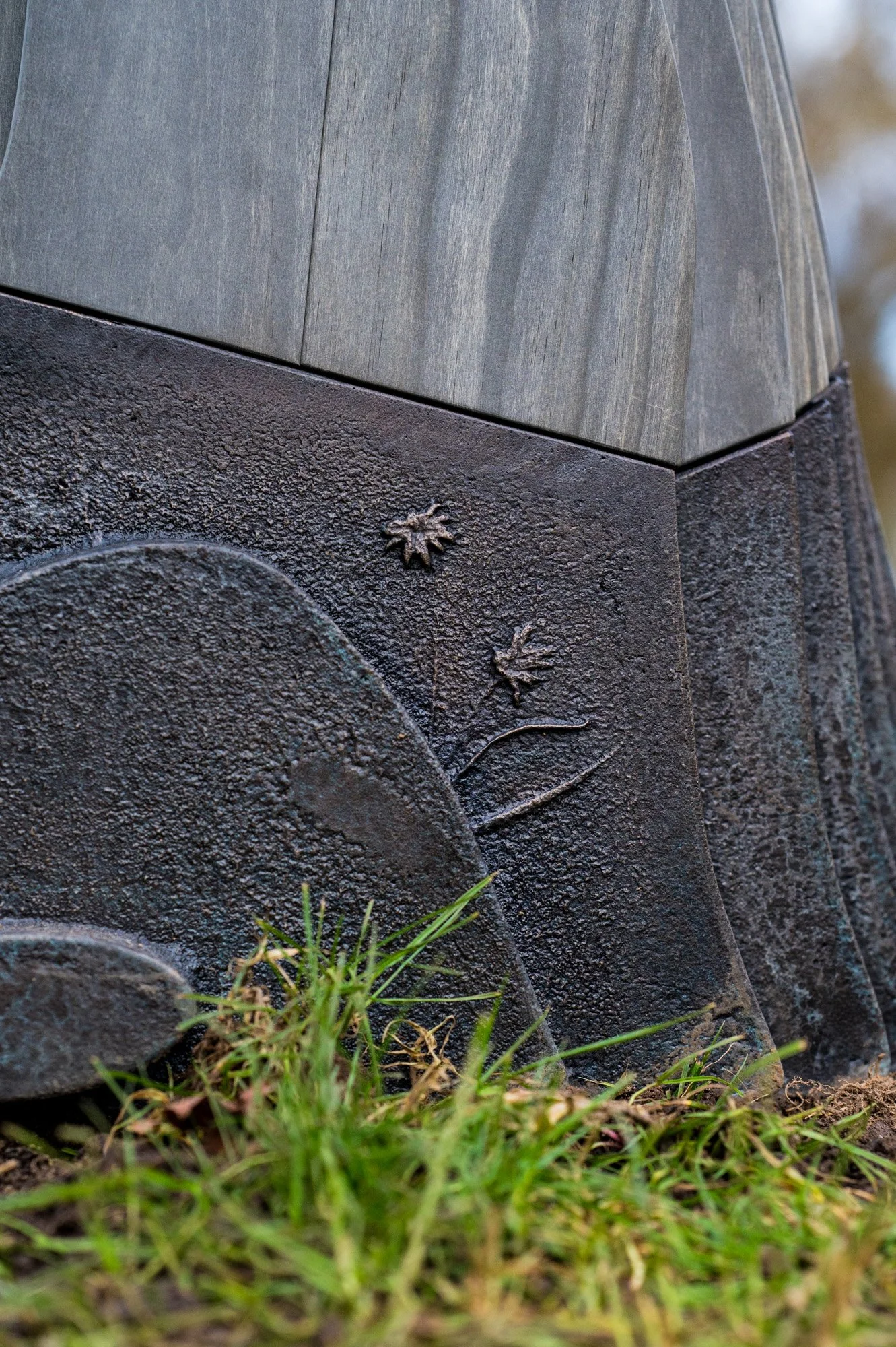
The anonymity of the figures also enables other potential readings of invisibility in relation to women, including the displacement of Djaara women from their traditional lands, which was occurring at the same time as the Castlemaine Art Museum and Gallery was being founded. The base of each sculpture holds impressions of three plants – kangaroo grass, lomandra and murnong (yam daisy) – which were of importance to Djaara women as staple food sources. These reliefs sit as acknowledgement of these intertwined histories of invisibility, erasure and resilience, in honour of Djaara women’s connections to culture, kinship and Country. I thank traditional owner Aunty Kerri Douglas for her guidance and expertise on this element of the artwork and on the selection of appropriate plants.
Despite its potentially heavy subject matter, “Wildflowers” has a sense of lightness and play, embodying the feeling of the gardens, of lying on green grass, of enjoying the air when surrounded by abundant and healthy plants. The figures, in their quiet contemplation of the gardens, contribute to that sense of slowing down, of breathing, that many experience when entering green spaces. I hope that they offer a moment of calm and reflection for visitors, and that in doing so, they help to tell this important story for many years to come.
Further information about the project and its history can be found here.